

MTV Turns 45: How Michael Jackson, Madonna and ‘The Real World’ Made TV History






What To Know
- MTV launched 45 years ago, revolutionizing music consumption by providing a 24-hour channel.
- The network quickly grew from 2.5 million to over 112 million viewers worldwide.
- MTV’s innovative format and charismatic VJs transformed both the music industry and pop culture.
Puffy shoulders and big hair. Synth music and glam looks. Yuppie materialism. Early, boxy home computers. The 1980s were known for many things, and we got to see them all in videos on the channel that was first known as Music Television. Back then in the nascent cable TV days, we yearned for something musical and new, a visual link back to the eras of American Bandstand and The Midnight Special that would fit the “greed is good” decade and somehow have more breadth than the same dull radio station formats. And we got a channel with both style and substance that aired 24 hours every day.
MTV memorably debuted over footage of NASA space launches with the words “Ladies and gentlemen, rock ‘n’ roll,” followed by VJ Alan Hunter and the first ever video to play, the Buggles’ “Video Killed the Radio Star” (also directed by Mulcahy). Back then it had 2.5 million subscribers; by March 1983, the national cry of “I Want My MTV!” had been heard and obeyed — TV Guide Magazine reported the network was then available in 1,300 cable systems around the U.S., watched by 9.5 million subs. By 1992, MTV reached 112 million homes around the world through both the mother-ship channel and a slew of sister networks.
After the channel powered up, performers old and new quickly came to understand the necessity of videos to attract fans. MTV proved the enormous value of seeing singers either dancing and lip-synching onstage to their songs (remember Loverboy? 38 Special? AC/DC?), or playing through some fantastical plot (Cyndi Lauper? Orchestral Manoeuvres in the Dark? Quarterflash? A Flock of Seagulls? Frankie Goes to Hollywood?). Filming a clip for your new single became paramount. In 1984, videos for “Hungry Like the Wolf” and “Girls on Film” earned Duran Duran the first ever Grammy for Best Short Form Music Video.
“A good video can really open the song up,” Ron Wood told TV Guide Magazine, and you could see Wood and the rest of the Rolling Stones, late in 1981, in the video for “Start Me Up,” after the band recognized that MTV was like one big national radio station, only better at creating hits. (Mick Jagger once referred to it as “the future.”) The five original VJs — Alan Hunter, Martha Quinn, Mark Goodman, Nina Blackwood and J.J. Jackson — were like our cool friends with whom we bonded over music. And suddenly we were listening to some performers — Peter Gabriel, Men at Work, the Pretenders, the Clash and, ultimately, Michael Jackson — as much for their beat as their sense of visual style and humor.
“‘Hungry Like the Wolf’ was my favorite clip for two months and still I can’t tell you what it’s about,” said Les Garland, the network’s early VP of programming. That didn’t matter; the video was disarming, wild, clever, original. Kinda like the best rock ‘n’ roll.
Touched For The Very First Time
“All of us who worked there in the early days knew that it was the greatest thing in the world,” says Richard Schenkman, a longtime filmmaker (A Diva’s Christmas Carol, The Man From Earth) who was among the handful of original hires at the network, and created “Hey, you — don’t watch that; watch this!” and other famed in-house promotions. “We knew that we were changing television. We knew we were the most important thing happening in the culture. We knew it the minute we signed on. We’re like, ‘Oh, this is going to be [expletive] great.’”
It would take a little time for the rest of the viewing world to catch on, but more national availability and artist and record company cooperation soon helped create a viewership firestorm, as young music fans spent hours watching the song clips the way they once might have listened to their favorite radio stations.
For rock fans of a certain age, the first decade or so of MTV (and the Jan. 1, 1985, launch of VH1, aimed at an older crowd) remains something of a wonder, a sudden portal to new music that became seminal and essential. It was a chance to appreciate both the evolving art of video clips and the amazing repetition of others. How many times did we have to see the Who demand “You Better, You Bet” in black and white, and Rod Stewart ask, “Da Ya Think I’m Sexy?” in gleaming color? At the same time, chances are good we might otherwise not have known who Boy George and Culture Club were, along with Adam Ant (with or without the Ants), had their clips not been in heavy rotation. And Annabella Lwin of Bow Wow Wow made it cool for women to have mohawks thanks to the “I Want Candy” video.

Frank Micelotta/Getty Images.
“[New] bands were emboldened and took full advantage of it,” says Craig Marks, coauthor of the book I Want My MTV: The Uncensored Story of the Music Video Revolution. “MTV helped create this art form, and that art form not only sold a tremendous amount of records, it minted stars, including, most importantly, Michael Jackson and Madonna.”
Along with a slew of provocative videos, from “Material Girl” to “Vogue,” Madonna’s star certainly rose courtesy of one of the most important programs the network created — the MTV Video Music Awards. After losing a shoe and wondering how best to save her performance on the first ever VMAs show in 1984, Madonna famously crawled across the stage, exposed more skin than she’d intended and sealed her stardom.
Black And White
Michael Jackson’s rise was more controversial. MTV execs infamously believed Black artists didn’t somehow fit in the network’s more rock-centric format. After record company threats, they premiered Jackson’s astonishing “Billie Jean” video on March 10, 1983, and entire genres of music were soon ushered in. Directed by John Landis, Jackson’s nearly 14-minute “Thriller” video premiered months later, capping that album’s historic rise. Five years later, Yo! MTV Raps debuted in the U.S., with Doctor Dré, Fab 5 Freddy and Ed Lover as hosts.
By then, MTV’s execs had begun to see the necessity of programming more formats and actual shows, realizing that, as Marks puts it, “Youth culture was really their medium, not music.” Safe-sex PSAs were introduced in 1985 in response to the AIDS crisis; that same year, the network well covered Live Aid — founded by Bob Geldof and Ultravox frontman Midge Ure — and showcased both outstanding performances (Queen’s set still remains a standard-bearer) and much-needed attention to famine conditions in Ethiopia. Alternative and grunge music became the late-night focus of 120 Minutes in 1986, and a year later, the appropriately named Headbangers Ball premiered as the sanctuary of metal heads across the nation.

Frank Micelotta/Getty Images
MTV, with its grip on young viewers, also became a laboratory for what the rest of television would end up creating in the future. (As Marks points out, 1984-89 crime drama Miami Vice “would never have existed if not for MTV music videos.”) Although the Loud family started the trend in PBS’ 1973 series An American Family, “MTV more or less invented reality TV when it aired The Real World,” Marks suggests, citing the 1992-2019 docuseries that put a group of young strangers together for months in a house and filmed them “getting real” about life. A few years earlier, Squeeze helped debut the series that would grow into Unplugged, and in August 1992, the album based on Eric Clapton’s episode would sell millions and win Grammys. A year later, in another Grammy winner, Nirvana famously appeared a few months before frontman Kurt Cobain‘s death.
As traditional music video programming continued to wane, the network pushed through in other areas. Starting in 1993, Mike Judge‘s animated sitcom Beavis and Butt-Head forged another cultural phenomenon, capturing slacker culture. And 1998’s Total Request Live made a star of host Carson Daly, giving him a platform with a Casey Kasem-type Top 10 show that also allowed for its share of crazy moments, thanks to guest star appearances.
Long Legacy

Everett Collection
Now, as the channel approaches year 45, the MTV behemoth has shown signs of age, recently shuttering its 24/7 global music-only supplementary channels, while staying focused on its main network in the U.S. and abroad.
That channel continued to break new ground over the last 25 years, especially in the reality realm. Would we have celebrity family docuseries TV at all without 2002-05’s The Osbournes? And excessively trashy guilty pleasure TV without 2009-12’s Jersey Shore? And without 2003-05’s Newlyweds: Nick and Jessica, starring Nick Lachey and Jessica Simpson, would we really know, philosophically speaking, that Chicken of the Sea is actually tuna?
Foundationally, MTV’s place as a cultural innovation force is inarguable, and its stamp is everywhere. “Two of the most prolific, popular filmmakers in the world, Michael Bay and David Fincher, got their start making music videos,” says Marks. “And if you look at commercials from the ’80s, those were all done in the style of quick-cut MTV videos.”
And it’s the early videos themselves that remain everything from a sigh-filled memory to a guilty pleasure. With several YouTube clicks, you can revisit those heady, big-haired days. Mark Metcalf’s “Douglas C.” from Animal House fame is hilariously prevented from torturing his family thanks to Twisted Sister declaring “We’re Not Gonna Take It.” Billy Joel shivers in an armchair because he could not handle “Pressure.” Michael Jackson ended a gang war in “Beat It” and “Weird Al” Yankovic stopped a food fight in “Eat It.” Diner waitress Chrissie Hynde served black coffee and the daily “special” in the Pretenders’ “Brass in Pocket.” And ZZ Top suggested in three videos that the sweet life could only be obtained if you possessed the key to a uniquely styled cherry red 1933 Ford “Eliminator” Coupe.
“The most important legacy of MTV is the music video; it begins and ends with that,” Marks says; those videos forever remade the way we think about music. And as fans, videos are the one thing that, to paraphrase 38 Special singer-songwriter Don Barnes, we will hold onto loosely, but won’t let go.
This article appears in the March 2026 1980s Music issue of ReMIND Magazine. You can purchase the full issue at the link below.

 Remind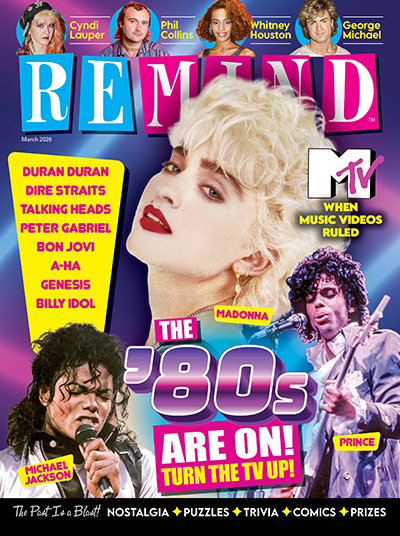
1980s Music Videos
March 2026
The hair was big, the tunes were loud and video was king! Look back to when 1980s Music Videos Ruled!
Buy This Issue