

This Forgotten TV Show Changed Sitcom History and Created ‘Happy Days’






t’s hard to think of a bigger TV success than Happy Days. The ABC show ran for 11 seasons, lived on endlessly in syndication, and turned its cast into cultural icons while defining the family sitcom for a generation. But its road to fame was anything but smooth. What began as a failed pilot eventually found new life as a single episode of an anthology series before becoming one of television’s most enduring comedies.
Before Happy Days became a hit in the ’70s and beyond, creator Garry Marshall created a few failed pilots featuring the Cunninghams. Marshall had written New Family in Town in 1971, focusing on a Milwaukee family in the 1950s that felt much like his own. The episode featured Ron Howard as Richie, Marion Ross as the matriarch Marion, Harold Gould as the patriarch Howard, and Erin Moran as Joanie. Even Anson Williams was there as Richie’s friend, Potsie. However, ABC passed on the initial pilot.
Back in those days, rejected pilots tended to stick around. “When you saw the pilot or made a pilot, if it did not sell, they put it on Love, American Style during the summer because they wanted to make their money back,” Marshall said in his Television Academy Foundation interview.
The pilot episode was retitled “Love and the Television Set,” (later changed to “Love and the Happy Days”) and aired on February 25, 1972, as part of the anthology series Love, American Style. At the time, many shows would feature special episodes introducing new characters that served as backdoor pilots to help launch a new show. At first, this one didn’t seem to capture the audience’s attention either … until George Lucas saw it.
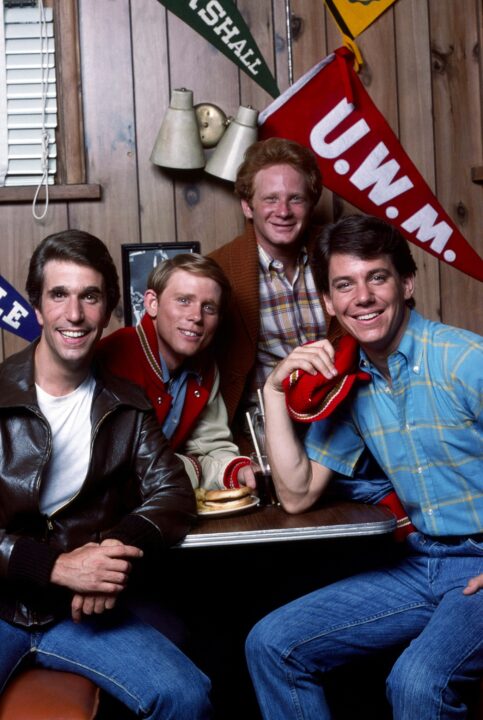
Carl Furuta/TV Guide/ABC /Everett Collection
Lucas was hunting for the right faces for American Graffiti in 1973, and he screened Marshall’s forgotten pilot. “Luckily, George Lucas did a movie called American Graffiti, which he used my pilot. He looked at it, Fred Roos was the casting director, and they found Ron,” Marshall said. The film hit, Grease was popular, and suddenly the ’50s felt nostalgic yet fresh for TV. ABC looked around for a nostalgia piece and realized they already had one sitting on the shelf. “They said, let’s get this topic. We got one of them, and they looked on their shelf and there was New Family in Town,” Marshall recalled.
The second attempt came with casting changes. Tom Bosley replaced Harold Gould as Howard Cunningham, and the writing had a lighter feel to it. “We wrote three scripts, the network was going to pick one to be the pilot,” Marshall said. The story they led with was teen-focused and provocative, but still squarely wholesome by eight o’clock standards. Howard had one non-negotiable request: no permanent high school loop. “He did not want to be a perennial old kid,” Marshall said, so they agreed Richie would grow up on screen, high school to college to whatever came next.
The early seasons were filmed like a little movie, with a single camera, then the network got nervous about the laughs they couldn’t hear. Marshall adapted, which he always did. He had learned from The Odd Couple to trust the audience, and he carried that lesson here. “I always liked the audience,” he said of taping with a crowd.
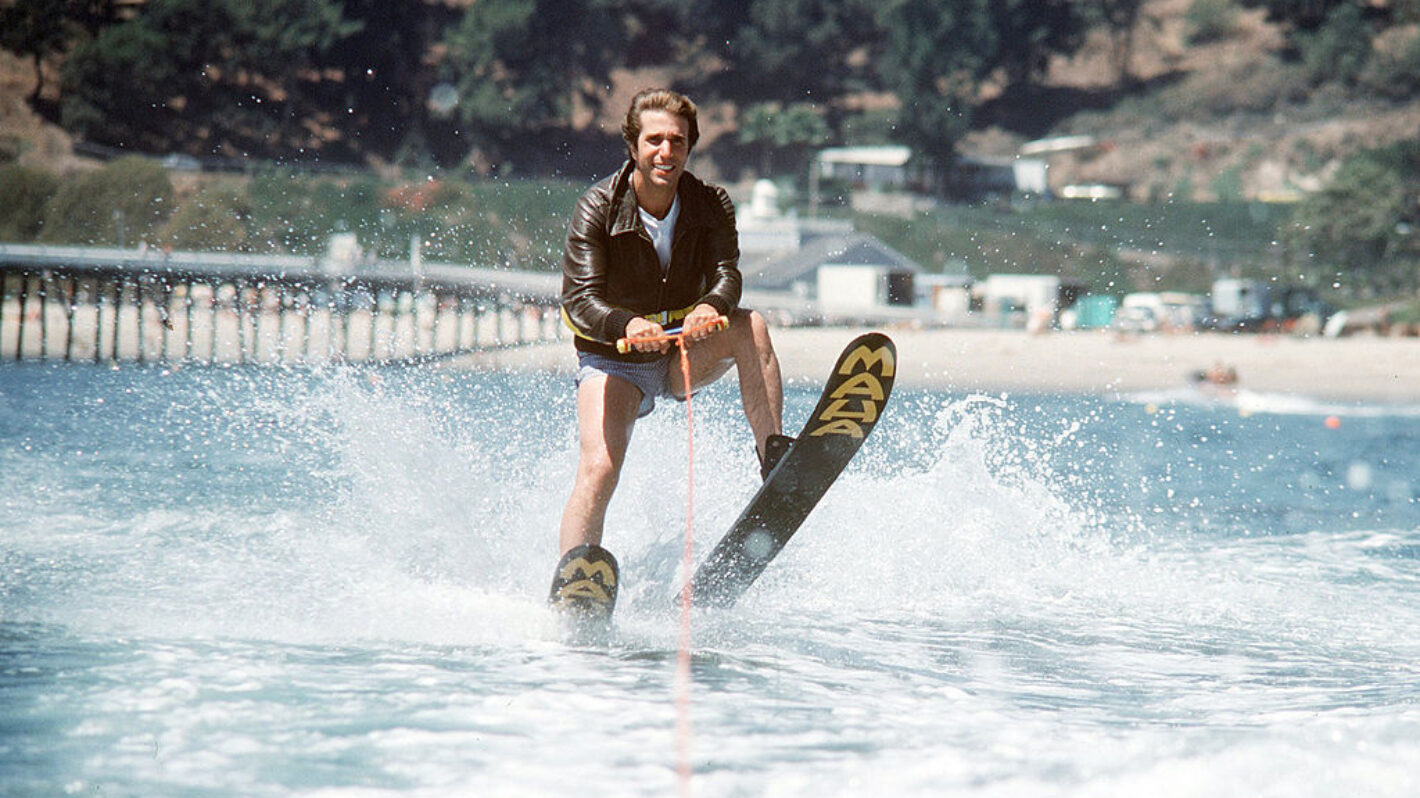
The switch to multi-camera brought that laugh energy into the show. He wanted something the whole family could enjoy at the same time, and he knew the magic trick would be a hero worth cheering. In Happy Days, the original focus was on Richie and Potsie, but audiences soon gravitated toward the rebellious breakout character, Fonzie (Henry Winkler). Marshall wasn’t surprised by the shift nor Fonzie’s popularity with viewers. “To me Fonzie was always a combination of Joe DiMaggio and the Lone Ranger,” Marshall added, with a laugh.
 Remind
1970s Fall TV
September 2023
Take a trip back to the ’70s by looking at the TV Guide Magazine Fall Preview primetime lineups.
Buy This Issue