

Hollywood’s Most Iconic Bad Boys: Brando, Dean, McQueen & Other Rebellious Screen Stars






Tony Curtis once said that he enlisted in the Navy after seeing the Cary Grant submarine classic, 1943’s Destination Tokyo. Since they first flickered on the screen, movies have been a window for observing human behavior and presenting archetypes that audiences could be inspired by. Guys especially wanted to ride tall in the saddle like John Wayne, take nothin’ from nobody like James Cagney‘s gangster characters, and be dashingly heroic like Errol Flynn’s outlaws.
These and other legends from Hollywood’s golden age seemed to know the secret of what it takes to be a man. Whether they were playing heroes or antiheroes, this now-vanished breed of movie star talked the talk and walked the walk, onscreen and off. We didn’t condone everything they did in their private lives, but their bad-boy behavior, very much in character, only added to their mystique.
These screen icons have stood the test of time because they were authentic. Their images were not tailored by publicists. What you saw was what you got, and we still can’t get enough. Here we honor 8 of the Best, in no particular order.
Lee Marvin

Everett Collection
A later-in-life movie star (he won his Oscar when he was 42), was bounced from a lot of schools growing up and was a World War II veteran. Onscreen, they didn’t get any meaner, tougher, or hard-boiled, as witnessed in 1962’s The Man Who Shot Liberty Valance and 1967’s Point Blank. When making 1967’s The Dirty Dozen, he would reportedly party all night and show up on the set with other cast members in tow in time to film. But the best story came from film critic Roger Ebert, whose interview with Marvin was interrupted by Marvin’s dog, who entered the room with women’s panties in his mouth. “Keep those panties out of sight,” Marvin said. Bad dog.
Humphrey Bogart

Initially best known for playing gangsters from the “dead-end” streets. He, too, played the tough guy when the cameras stopped rolling. A producer once took him to a Sunset Strip gambling joint, but they were refused entry because of past disturbances caused by Bogart. When the producer insisted that he was now sober, the bouncer told him to look behind him; Bogart was fighting with two parking lot attendants. Perhaps legendary restaurant owner Dave Chasen said it best: “The only trouble with Bogart is that he thinks he’s Bogart.”
Robert Mitchum

Everett Collection
Was a film noir poster boy. His father died in a railroad accident when Mitchum was a toddler. He was expelled from schools. He was sentenced to a chain gang when he was a teenager. He bummed around Depression-era America. He was busted for marijuana … in 1948! When it came to Hollywood, he had a take-it-or-leave-it attitude, yet still became a cinematic legend with films like 1945’s The Story of G.I. Joe, 1953’s Angel Face, 1967’s El Dorado, 1962’s Cape Fear, 1955’s The Night of the Hunter, and more than 100 other films to his credit. He once said, “People can’t make up their minds whether I’m the greatest actor in the world — or the worst. Matter of fact, neither can I.”
Errol Flynn

Everett Collection
We’re talking Hollywood bad boys, so just how bad was Errol Flynn? The title of his autobiography, My Wicked, Wicked Ways, is a clue. Flynn was so devil-may-care daring onscreen in 1938’s The Adventures of Robin Hood and 1935’s Captain Blood, and offscreen as a hard-drinking womanizer beset by sexual scandals and reckless spending. But he believed in keeping up appearances. “It is a habit of mine,” he wrote, “when you are down and out, go to the best spots.” He died in 1959 at the age of 50 and was found by his teenage girlfriend, whom he started dating when she was 15.
Marlon Brando

Everett Collection
Some Hollywood icons were considered geniuses of their craft. Perhaps that gave them license to, shall we say, act out. Marlon Brando, who revolutionized screen acting, displayed open contempt for his profession. Pity the director he didn’t respect. He initially demanded that his Jor-El character in 1978’s Superman be designed to look like a suitcase or a green bagel. But no matter; he remained revered, and the chance to work with him was — you guessed it — an offer you couldn’t refuse.
James Dean

Everett Collection
Much to Brando’s disdain, James Dean actually patterned his rebellious ways after the legend. The cult of Dean, however, is very much wrapped around the tragic car crash that ended his life at the age of 24, with only three feature films to his credit. In two of those films, 1955’s East of Eden and Rebel Without a Cause, he defined 1950s teen angst, which was anything but happy days.
Richard Burton

20th Century Fox Film Corp./Everett Collection
Never mind the prodigious drinking or his infamous love life. Burton’s scandalous affair with Elizabeth Taylor on the set of 1963’s Cleopatra rocked Hollywood in the 1960s and made them the tabloids’ most wanted. He reportedly once said of himself, “I rather like my reputation, actually, that of a spoiled genius from the Welsh gutter, a drunk, a womanizer; it’s rather an attractive image.”
Steve McQueen

Everett Collection
Not for nothing was Steve McQueen nicknamed the “Cooler King” in 1963’s The Great Escape. There was no one cooler. He raced cars, never watched his own films, and was a style icon. He was also a notorious womanizer, which might have saved his life. According to an ex-wife, he picked up a woman and then backed out of dining with Jay Sebring and Sharon Tate the night followers of Charles Manson slaughtered them.
This article originally ran in the 2019 Hollywood Hunks Issue of ReMIND Magazine. You can purchase the full issue at the link below.

 Remind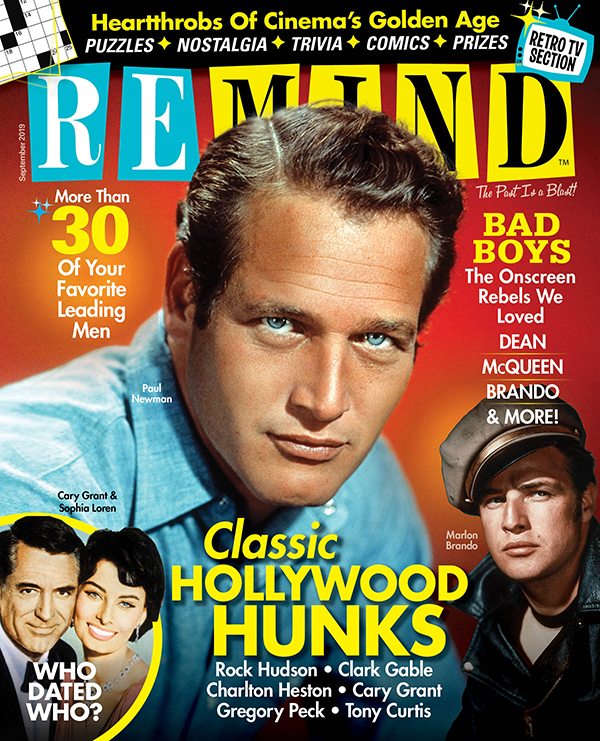
Classic Hollywood Hunks
September 2019
Cary Grant, Sean Connery, Rock Hudson and Paul Newman, smoldered onscreen and, in addition to being smokin’ hot, they were effortlessly cool.
Buy This Issue