

Douglas Fairbanks: How Hollywood’s First Swashbuckling Superstar Changed Action Movies



What To Know
- Douglas Fairbanks became Hollywood’s first swashbuckling superstar in silent-era action films.
- His roles in classics set new standards for action sequences in cinema.
- Fairbanks’ energetic performances and visual flair established a template for action heroes.
From the earliest days of silent cinema, swashbuckling films borrowed inspiration from the enduring period and costume adventures written by the likes of Alexandre Dumas and Rafael Sabatini. They were catnip to an audience that thrilled at audacious displays of derring-do, catapulting the athletic and charismatic Douglas Fairbanks Sr. into immortality as one of Hollywood’s first big-screen superstars, who proudly claimed to have performed many of his own stunts.
Douglas Fairbanks was the first to slash the infamous “Z” in The Mark of Zorro (1920), adopting a foppish facade to cloak his heroic exploits (a signature trick of The Scarlet Pimpernel as well), leaving the scar of a “Z” as his calling card, but no “zzzz’s” of boredom in the movie house. His carefree performance set the standard for playful swordplay, interrupting one breathless pursuit to enjoy breakfast. “Never do anything on an empty stomach,” he winks at an astonished servant.

Everett Collection
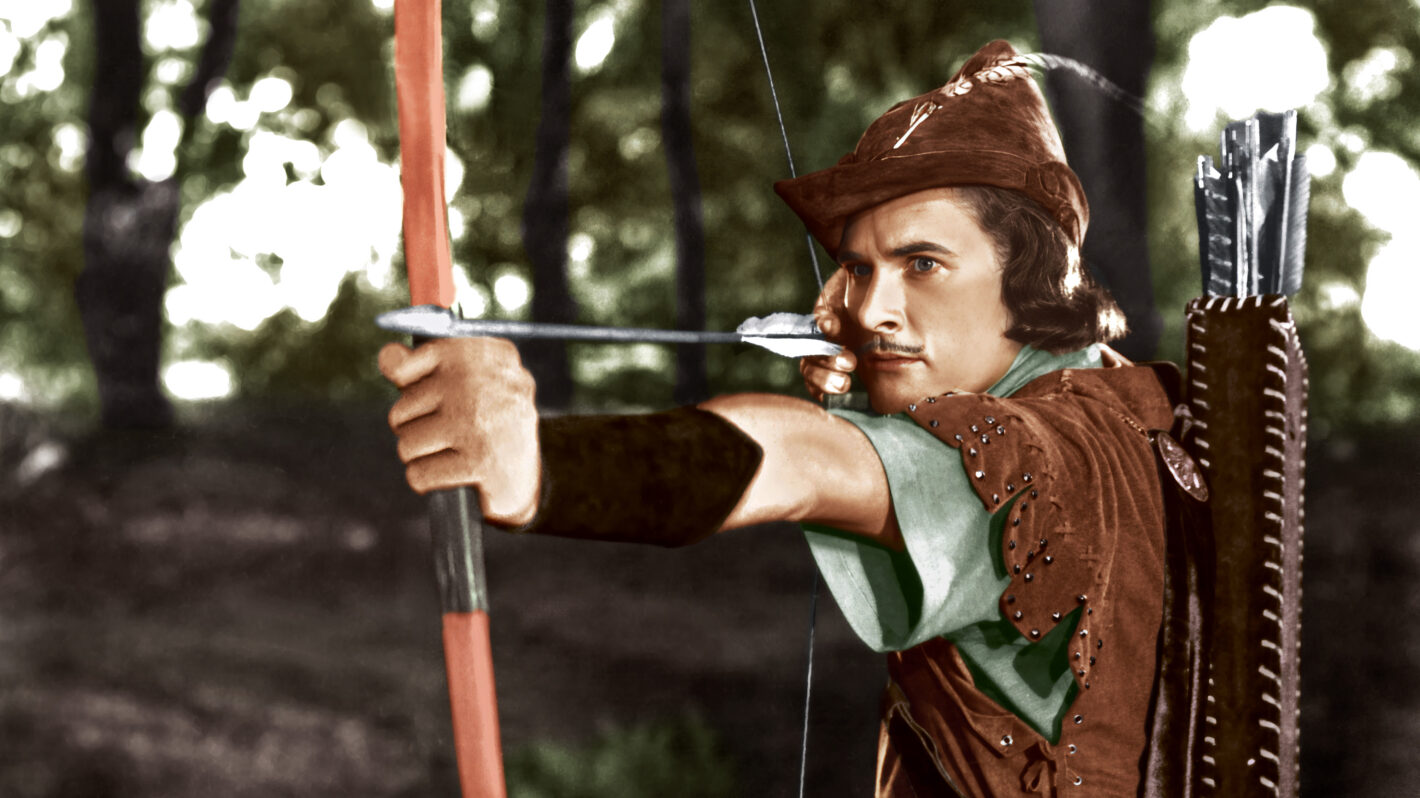
This success led Fairbanks directly to early versions of the oft-filmed The Three Musketeers (1921) as D’Artagnan, and Robin Hood (1922) in the title role, followed by a fan favorite: The Black Pirate in 1926. That film, produced in an innovative two-strip color process, features one of the star’s most memorable signature stunts, as he makes his way down from the top of a ship using the blade of his knife to slice downward from sail to sail. It’s still a breathtaking sight to behold — and was copied more than 25 years later in an homage by his successor, Errol Flynn, in 1952’s Against All Flags.
As Salon critic Charles Taylor observes, “Leaping onto tabletops and mantels, swinging up to plunk down on a railing and laugh at his furious foe, even keeping up a flurry of sword work while he’s lying flat on his back, Fairbanks is a perpetual motion machine.” Perfect for an era when dialogue was secondary to visual flair. Fairbanks’ acting career didn’t extend long beyond the advent of the talkies, but he set a high bar for all who would follow.
This article originally ran in the April 2026 Swashbucklers Issue of ReMIND Magazine. You can purchase it at the link below.
 Remind

Swashbucklers
April 2026
Celebrating our favorite swashbucklers — brave and bold buccaneers on land and sea.
Buy This Issue