

What Are Alan Alda’s Favorite ‘M*A*S*H’ Episodes? The Actor Reveals His Picks





What To Know
- Alan Alda finds it difficult to choose a single favorite M*A*S*H episode, instead listing over 30 episodes he loves for their diversity in style and tone.
- He highlights episodes like “Tuttle,” “Iron Guts Kelly,” and “The Late Captain Pierce” for their blend of satire, comedy, and underlying themes of mortality.
When TV Guide Magazine asked me to write about my favorite episode of M*A*S*H, I suddenly realized I didn’t have one. The problem, I explained to a friend, is that there are 10 or 12 shows I really love and I can’t put any of them above the others. “All right,” my friend said, “then what are your 12 favorite shows?”
I wrote out a list, and there were 34 titles on the page.
Well, at least I didn’t write down all 250 of them. I have some discrimination.
When I look at the list, I think I see one of the strong reasons we’ve been able to stay interested, in fact stimulated, all these years doing the same show. The reason is we haven’t been doing the same show. We’ve been able to work in a wide range of styles: comedy, drama, satire, burlesque, romantic comedy, farce and, as Radar would say, just plain “stupidity.”
The satirical shows have had a nicely bent quality to them. Like “Tuttle” (Season 1 Episode 15), written by Bruce Shelly and David Ketchum, about an imaginary Captain Tuttle invented by the 4077th, who becomes all too real to the Army and, as a result, increasingly burdensome to his inventors. Or “Iron Guts Kelly” (Season 3 Episode 4), by Larry Gelbart and Sid Dorfman, about a blood-and-guts general who inconveniently dies in the arms of Eros instead of in battle, and whose aide insists, for the sake of appearances, that the body be stashed for a while until a suitable battlefield can be found in which to prop the old boy up. Or “The Late Captain Pierce” (Season 4 Episode 4), written by Glen Charles and Les Charles, in which, through a bureaucratic tangle, Hawkeye is pronounced dead. He has such a hard time convincing the Army he’s alive that he seriously considers taking their word for it — and going home.
Clearly, in even our most antic moments, death is usually lurking just behind the door, even if sometimes he’s wearing a fright wig and carrying a pig’s bladder. And I’ve always been glad the audience has accepted that in our show. When I’m in the audience, I like comedy that admits life is not a cinch and tragedy that knows there is still laughter.
0th Century Fox Television./Courtesy Everett Collection
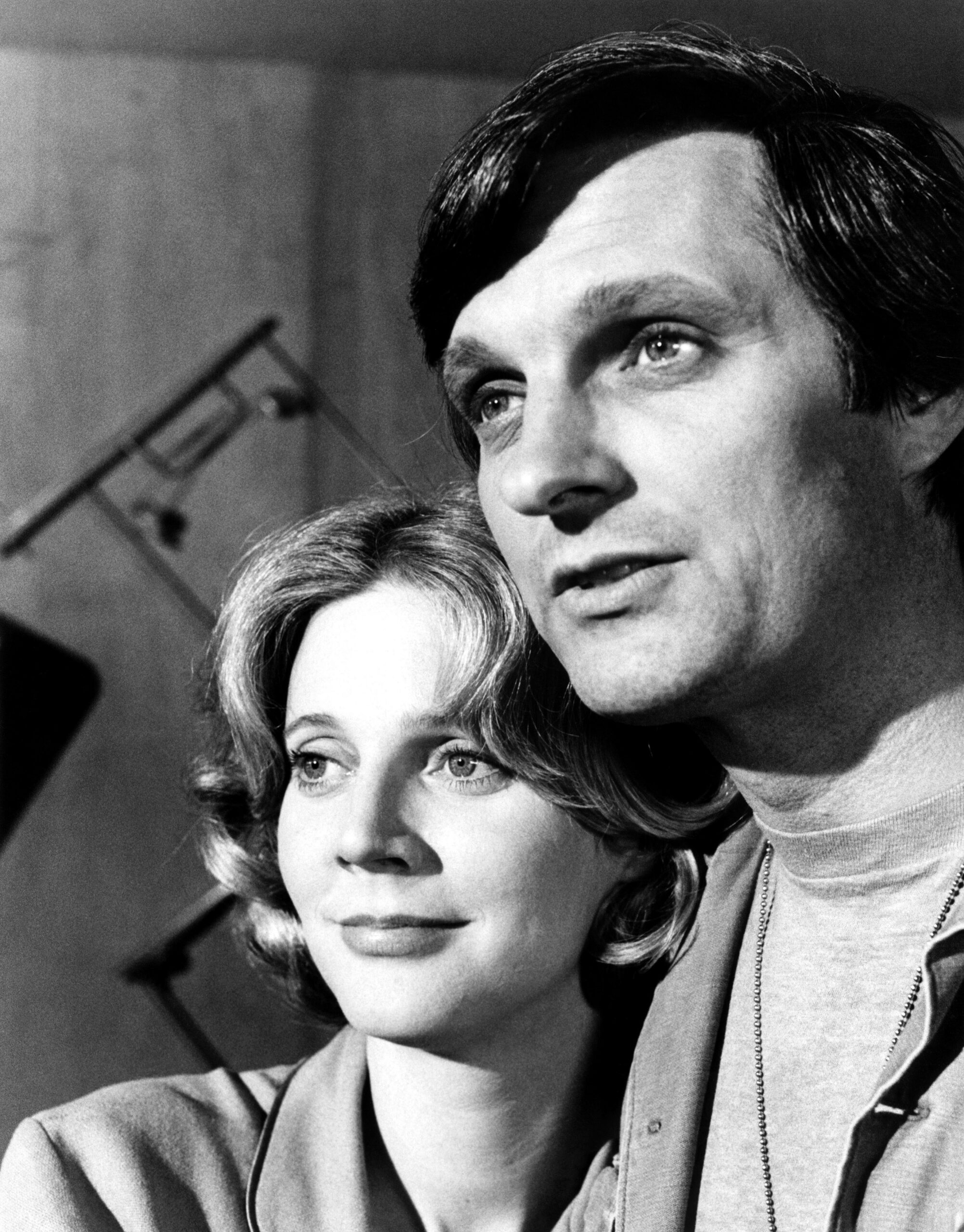
Most of our best romantic comedies have kept an eye on the war, giving them a bittersweet quality, but what made them even more so was acknowledging that romance itself can be a war of conflicting personalities. Like “Foreign Affairs” (Season 11, Episode 3), written by Elias Davis and David Pollock, in which Charles Emerson Winchester has just a little too much Boston in him to love a woman with all that much Paris in her. And “The More I See You” (Season 4, Episode 23), written by Larry Gelbart and Gene Reynolds, which was the revival of an old mismatch between Hawkeye and a former love played by the translucent Blythe Danner. Whenever I see that show, I always ache for those two people as they try to figure out how they could love each other so passionately and yet not be able to stand one another for more than a few days at a time.
“Comrades in Arms” (Season 6, Episodes 12-13), which I wrote, tells the story of the world’s most unlikely couple: Hawkeye Pierce and Margaret Houlihan. Normally, they’re barely able to tolerate one another, but one night during a shelling they’re both so scared, lonely, and vulnerable that they fall into each other’s arms. They wake up the next day with what you could call a “romantic hangover,” both desperate to ditch the ridiculous mistake sitting next to them.
“Comrades in Arms,” a double episode, is an example of the kind of collaborative spirit we’ve come to take for granted on M*A*S*H, and which will be hard to leave behind. Because it was such a long piece, Burt Metcalfe and I decided we’d like to codirect the show. This is not often done, and in fact we had to get a special dispensation from the Directors Guild. The result was enormous pleasure for both of us, and even though directing is very much the expression of a personal vision, I doubt either of us could be sure today who contributed what.
“In Love and War” (Season 6, Episode 7) is a romantic story not so much of conflicting personalities as conflicting responsibilities. In it, Hawkeye falls in love with a Korean woman. She has to move on to care for the children she’s taken under her wing, and he has to stay and operate on the endless stream of wounded soldiers. I never see the show without lamenting one of the exigencies of the television wars, which is that every show has to be the exact same length. This story seemed just about right at 40 minutes. But at half an hour, some of the scenes are too abrupt. But I remember the 40-minute version, so I love it anyway.
Time is your enemy in television, not just because of the length of your stories, but also because deadlines hang over you like death sentences. Sometimes, though, you get lucky. The story for “Fallen Idol” (Season 6, Episode 2), where Radar is disillusioned by Hawkeye, somehow came out of my mouth in about five minutes instead of the usual grueling several days. And Burt Metcalfe and I remember with pleasure and some amazement the night he and I wrote the entire second act of “The Party” (Season 7, Episode 25) in an Italian restaurant. If we’d had the time, we might have taken longer, but I don’t know if we’d have been happier.
“Inga” (Season 7, Episode 17) won me an Emmy as a writer, which I guess was the first time in the history of the Academy anybody did a cartwheel on the way to the stage. Played superbly by Mariette Hartley, Inga is a Swedish doctor with whom Hawkeye falls in love even before he meets her. His ardor cools somewhat when she bests him in the operating room, and Hawkeye is surprised to find that he has difficulty learning from a woman.
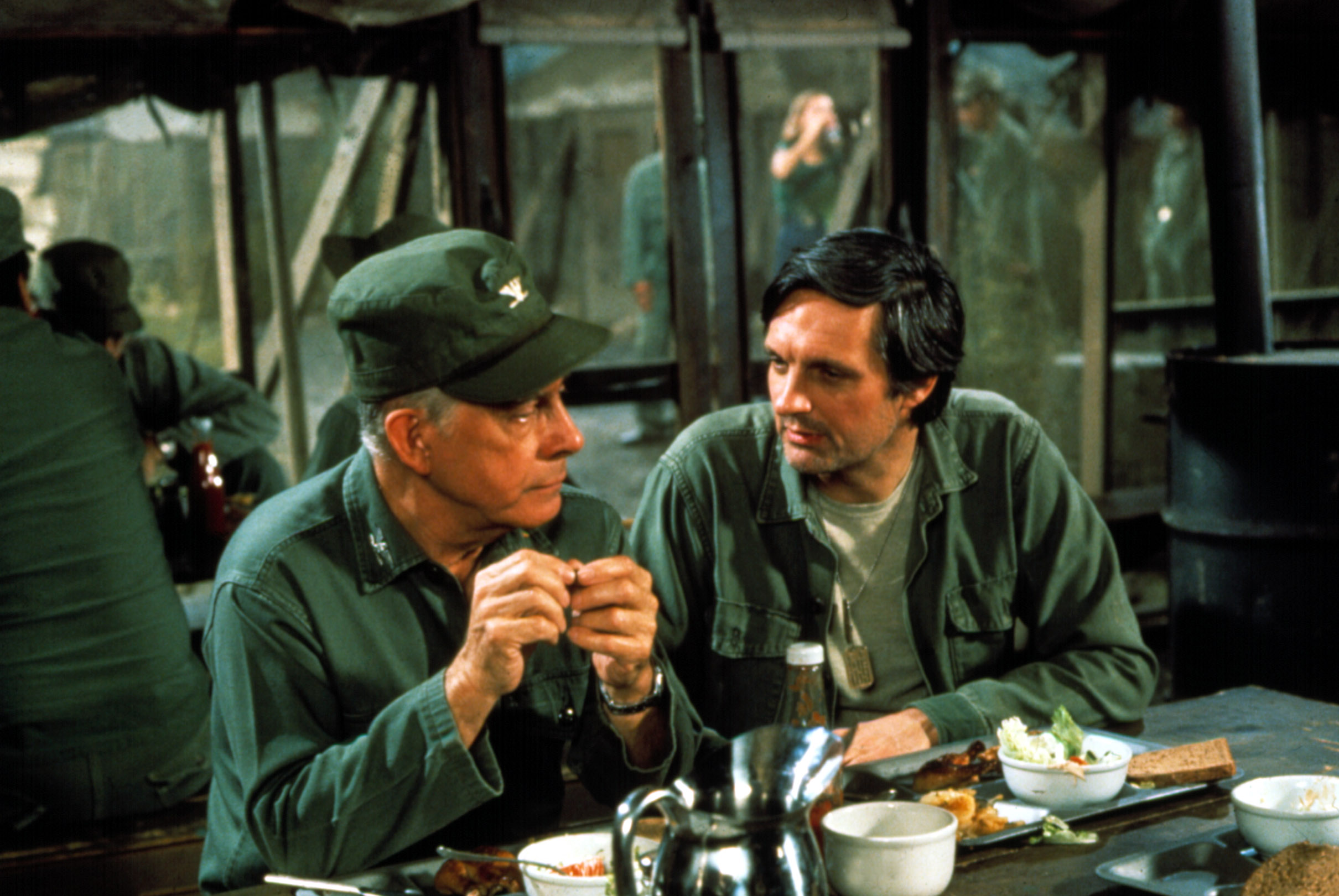
No matter how serious an episode is, of course, there’s always something to laugh about in a M*A*S*H story, so when I think of drama on the show, I’m usually thinking of isolated moments. Moments as in “Period of Adjustment” (Season 8, Episode 6), written by Jim Mulligan and John Rappaport, where Mike Farrell falls so eloquently to pieces as a father separated from his daughter by the war. And “Old Soldiers” (Season 8, Episode 18), written by Dennis Koenig, in which Harry Morgan toasts his dead comrades from World War I. We often do many takes of each shot on M*A*S*H, going as high as 20 or more because something is not going quite right. When Harry played this scene, he was perfect from the first moment, but we still had to do a number of takes. The problem was, none of the rest of us could watch it without blubbering. In fact, he was so moving, once or twice he even got himself going.
20th Century Fox Television./Courtesy Everett Collection
The show that broke ground for us and enabled us to have serious moments like this and therefore to explore what was under the top layer of frivolity was a show called “Sometimes You Hear the Bullet” (Season 1, Episode 17), written by Carl Kleinschmitt. In it, an old friend of Hawkeye’s dies on the operating table. It was the first time on our show that a sympathetic and charming character had died. (In fact, it was probably one of the few times it had happened in television comedy.) At least one executive at CBS said, “What are you doing? Is this a comedy or a tragedy?” Larry Gelbart and Gene Reynolds, though, stuck by the episode, and thanks to their persistence, we’ve been able to deal with both the dark and the light sides of life since then. I like it better that way.
It seems to me that, unlike most of television, life doesn’t come in a choice of comedic or dramatic form. There’s always a less-than-convenient mix of laughter and tears. It’s harder to write and act that mixture, but when you can make it work, you feel very good about yourself.
As a result, “Sons and Bowlers” (Season 10, Episode 20), by Elias Davis and Dave Pollock, and “Bless You, Hawkeye” (Season 9, Episode 17), by Thad Mumford and Dan Wilcox — episodes where Hawkeye is handling his anxiety by being lighthearted on the surface while deep emotion unexpectedly bubbles to the top — were times for me when I felt able to do things as an actor that I had never been able to do before. I had always admired those actors who could be overtaken by emotion apparently by surprise — as if something rises unexpectedly from your unconscious and clutches you by the throat. I’m grateful to the writers of “Sons and Bowlers” and “Bless You, Hawkeye” for inventing moments that were so strong, it was hard not to be overtaken by them.
In general, I think all the actors on M*A*S*H feel a special sense of gratitude to all the writers. People often ask us if we improvise a great deal on M*A*S*H, and are surprised to hear that, with very few exceptions, we’ve never changed a word without consulting the writing staff. That respect for the written word began with our first show and continued through our last episode.
The staff, headed first by Gene Reynolds and Larry Gelbart and for the past six years by Burt Metcalfe, has been the foundation of the show. In the early years, that staff included Larry Marks and Jay Folb. In the middle years, we had Ronny Graham, Larry Balmagia, and the teams of Don Reo and Allan Katz and Ken Levine and David Isaacs. In the later years: John Rappaport, Jim Mulligan, Dennis Koenig, Karen Hall, and the teams of Thad Mumford and Dan Wilcox and David Pollock and Elias Davis. I think it’s important to name them because unless you’ve sat with the writing staff hour after hour as they’ve shaped stories and sharpened dialogue, you have no way of knowing how many talented hands have helped fashion the greater part of anyone’s list of favorite shows.
Among our most interesting shows, I think, are those in which we tried to tell a story in an entirely different form. Most striking of these is “The Interview” (Season 4, Episode 24), written by Larry Gelbart. Shot in black and white and totally without a story, it is a series of interviews between the members of the M*A*S*H unit and newscaster Clete Roberts. It was made to look like a documentary that had been shot in the ’50s, and in fact, Clete Roberts himself had been in Korea at that time doing similar interviews.
We worked unusually on this show. Interviews were taped with the actors responding in character and those transcripts were used by Larry as the basis for his script. Then, once on camera, Clete Roberts would ask us questions we had never heard before so that a little of what you see in that show is on-the-spot improvisation. It was an exciting way to work, but we never found a way to do it again.
Larry Gelbart came up with the device of telling many little stories in one show by making them parts of a letter home in a show called “Dear Dad” (Season 1, Episode 12). I used the idea in “Dear Sigmund” (Season 5, Episode 7), in which the bizarre behavior of the members of the 4077th is described by a depressed psychiatrist, Sidney Freedman, in an imaginary letter to Sigmund Freud.
In “Point of View” (Season 7, Episode 10), written by Ken Levine and David Isaacs, we told the story entirely through the eyes of a soldier from the time he is wounded in the throat through all the stages of his treatment, until that moment when he’s finally able to whisper a hoarse “thanks.” You never see the soldier, but instead see only the things he sees. We wanted to give the audience a feel for the experience through the patient’s eyes, something that we had never been able to do until then.
20th Century Fox Television./Courtesy Everett Collection
Part of the fun in unusually telling a story is that you’re never quite sure it’s going to work. I felt I was taking a big chance, for instance, in “Life Time” (Season 8, Episode 11), which I wrote with Dr. Walter Dishell. For quite a while Burt and I had wanted to tell a story in real time — that is, 30 minutes in the life of the M*A*S*H characters to fit into the 30 minutes that the show is on the screen. Having the M*A*S*H characters do a vein-graft operation within that limit seemed like a good idea, but once we decided to put a clock in the corner ticking off the seconds, I got nervous. I had this deadly feeling that for half an hour 20 million people would be staring at the clock and ignoring the story.
We used the form of a monologue in a show called “Hawkeye” (Season 4, Episode 18), written by Larry Gelbart and Simon Muntner, in which Hawkeye has had a jeep accident and finds himself marooned with a family of Koreans, none of whom speak any English. Suffering from a head injury, Hawkeye is afraid to stop talking for fear of losing consciousness. As an actor, it was one of the toughest shows I’ve filmed, because seconds before each take, Larry and I would be writing and rewriting speeches that would go for five or six minutes at a clip. It’s hard enough to remember all those words, but when you’re trying to remember which of the 15 possibilities for each word you have actually chosen, your eyes begin to dance in your head. The possibilities were tantalizing.
“Dreams” (Season 8, Episode 22), which I wrote from a story by James Rubinfier, was a chance to tell the story visually in a way that was different for M*A*S*H. In the show, during a period of heavy casualties, at odd moments people lie down exhausted for catnaps. Their dreams of longing and frustration, anxiety and helplessness in the face of war, gave us a chance to have a bizarre look at the insides of the minds of these characters, which was certainly a view of them we had never attempted before.
In as many ways as we could find, we’ve tried to show different sides of the characters, and now, after 11 years, we hope to stop just before we run out of ways of looking at them. We’ll make one last effort to see something new in the characters on the movie that ends the series, and then we’ll let them go.
I think that final program will be one of my favorites. In it, as we have in most of our shows, we tried to be a little funny, a little touching, and a little different.
One thing we know — a bit sadly: We have nothing we can follow it with.
Note: Episode numbering can vary by source due to how syndication packages split double-length episodes.
— By Alan Alda, TV Guide Magazine, February 12, 1983
From the TV Guide Magazine Archives
 Remind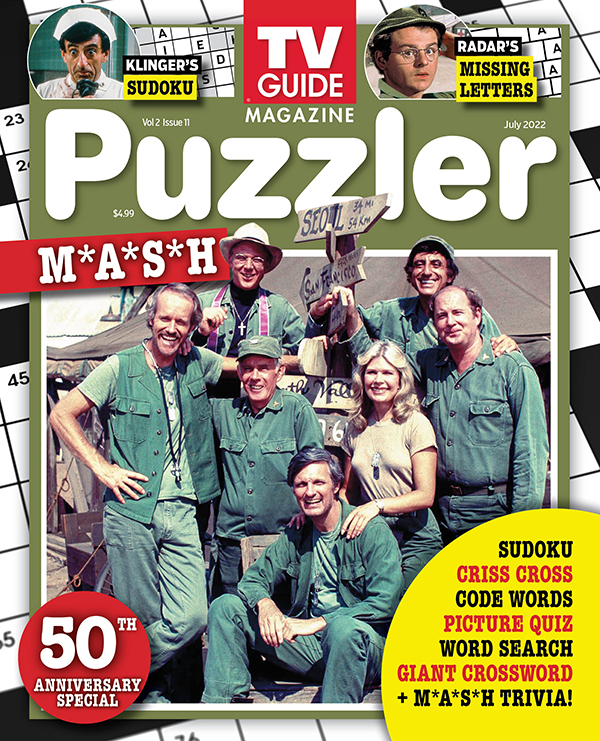
PUZZLER: M*A*S*H
Vol. 2, Issue 11
Celebrate everything about the series, great for fans and newbies!
Buy This Issue