

‘Iron Eagle’ Was No ‘Top Gun’ — But It Did Top the Box Office 40 Years Ago






What To Know
- Iron Eagle, released four months before Top Gun in 1986, featured a teenager and an Air Force reservist stealing F-16 jets to rescue the teen’s captured father, but was overshadowed by Top Gun’s later success.
- The film was made without U.S. Air Force cooperation due to its plot about stolen jets, with aerial scenes filmed in Israel using real Israeli Air Force pilots and a $10 million budget.
- Despite poor critical reviews, Iron Eagle topped the box office on its opening weekend, grossed $24.2 million domestically, and spawned three sequels due to strong home video sales.
For fans of filmic fighter-jet fare, 1986 was a banner year. That was, of course, the year Tom Cruise flew into the “danger zone” in Top Gun. But four months prior, a similar film took flight, one that Top Gun has since overshadowed in our pop-culture consciousnesses. We’re talking, of course, about Iron Eagle, which premiered on January 17, 1986, and was perhaps the definitive action drama in which a teenager purloins a U.S. Air Force warplane.
Iron Eagle tells the story of another hotshot pilot — one who rescues his father
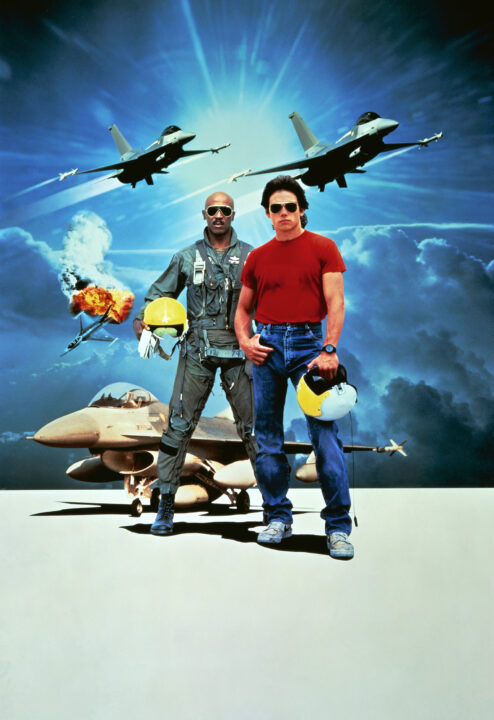
(c) TriStar/courtesy Everett Collection
In Iron Eagle, Jason Gedrick plays Air Force Academy reject Doug Masters, who learns his father, a veteran Air Force pilot, has been shot down and captured by the fictional Middle Eastern country of Bilya. So Doug and Air Force Reserve member Col. Charles “Chappy” Sinclair, played by Lou Gossett Jr., steal two F-16 jets and launch a rescue effort behind enemy lines.
Director Sidney J. Furie directed the film and cowrote the script with Kevin Alyn Elders, a production supervisor on Furie’s 1984 Vietnam War film, Purple Hearts.
Elders was a first-time screenwriter, but “he could talk,” Furie told the Los Angeles Times. “Boy, could he talk. And after we returned from making that movie in the Philippines, we sat down and said, ‘Let’s make the kind of movie we used to sneak in to see on Saturday afternoons.’”
That idea became the story of “a heroic young person who’s involved in something daring,” the filmmaker said.
Since the story involved stolen jets, the real U.S. Air Force couldn’t be involved
Much of Iron Eagle was filmed in Israel, with real pilots from the Israeli Air Force performing aerial maneuvers in the background.
“We knew it was no use approaching the U.S. Air Force,” Furie explained to the Times. “They have a longstanding policy about not cooperating on any film which involves the theft of a plane. They’re very sensitive about that, probably because they know how easy it is to do.”
The AFI Catalog notes Iron Eagle was filmed with rented F-16 jets amid real-life training missions on an Israeli Air Force base, with a five-week shoot and a $10 million budget.
The film didn’t get high-flying reviews
For the most part, Iron Eagle crashed and burned with critics. “There’s no apparent logic to any of this, except as a way to capitalize on the current vogue for imperialist fervor and steal the thunder from Paramount’s Top Gun,” wrote The Washington Post’s Paul Attansio.
The Globe and Mail’s Salem Alaton opined, “The vulgarity and jingoism of Iron Eagle prevent it from functioning even as breezy entertainment.”
Time Out, meanwhile, said Iron Eagle has “the highest of production values” and “the cheapest of stories” while TV Guide Magazine deemed the film “yet another totally absurd bout of macho wish fulfillment.”
Iron Eagle hit No. 1 at the box office but only grossed $24 million
With a $6.1 debut, Iron Eagle topped the North American box office for the weekend of January 17, 1986, edging out The Color Purple ($5.7 million) and Out of Africa ($5.2 million) in each film’s fifth week of release, Box Office Mojo reports. Other new releases that weekend ranked far behind:Troll, for example, only grossed $2.6 million.
Iron Eagle ended its North American theater run with a gross of $24.2 million, far below the $176.8 million Top Gun grossed in its original release later that year. But Iron Eagle’s home-video performance had studio execs wanting more. “It generated $11 million in video cassette sales, which is what sold TriStar on the sequel,” producer Ron Samuels told the New York Daily News.
Three sequels followed, all starring Lou Gossett Jr.
Furie directed a sequel, Iron Eagle II, which hit theaters in 1988. In that story, which Furie again cowrote with Elders, Chappy leads a joint U.S.-Soviet strike force in an attack against a rogue nation gone nuclear.
Then came 1992’s Aces: Iron Eagle III, which Elders wrote but John Glen directed, in which Chappy commands a vintage squadron of fighter planes to take on a drug-smuggling ring.
And the series ended — for now, at least — with the 1995’s Iron Eagle on the Attack, a direct-to-video sequel that had Furie return as director and reunited Chappy and Doug, now played by Jason Cadieux. In that story, Chappy’s teen flight students — yes, adolescent heroes again — face off against rogue Air Force pilots.