

The Surprising Thing ‘Sesame Street’s Creators Hated About the Show






What To Know
- The producers of Sesame Street originally disliked the show’s title, selecting it as the “least bad” option among several uninspiring alternatives.
- Despite initial concerns, the name Sesame Street became iconic, with its “open sesame” reference symbolizing education opening the world to children.
- The show’s set was intentionally designed to reflect a realistic, inner-city environment, resonating with children from urban neighborhoods.
Can you imagine Sesame Street by any other name? Say, 1-2-3 Avenue B? Or even, heaven forfend, Fun Street? The seminal children’s show — which debuted on November 10, 1969 — could have easily gone by another title, considering how much co-creator Joan Ganz Cooney and her colleagues didn’t like its eventual moniker.
That’s just one anecdote in the storied history of Sesame Street, which was “truly an experiment in teaching children using the new medium of television,” as Ellen Crafts, a producer of the documentary Street Gang: How We Got to Sesame Street, told The Guardian in 2021. “These incredible people came together and were responding to a shared social consciousness, and were going to use television and creativity to ultimately try to change the world.”
As the show begins its 56th season on both Netflix and PBS Kids, it’s shocking to realize that the selection of Sesame Street as a title was just one aspect of the show that almost went a different direction.
Producers thought Sesame Street was the “least bad” option
Robert Fuhring/TV Guide/PBS/Courtesy Everett Collection
In a 1998 interview with the Television Academy, Cooney said that the title Sesame Street was a late addition to the production — and not a popular one at that.
“We were frantic, just frantic, for a title, and our press and publicity people were going nuts. I mean, how were they going to promote the show?” she said.
Louise Gikow, a writer who worked with Jim Henson Productions, wrote in her book Sesame Street: A Celebration — 40 Years of Life on the Street that the team had considered The Video Classroom, 1-2-3 Avenue B, and even “the mundane Fun Street,” in Cooney’s words.
“So finally, we said there is no more time, and we had a list of titles that writers and others had contributed, and somehow we decided Sesame Street was the least bad,” Cooney told the Television Academy.
But she and the other producers didn’t like the selection, with Cooney explaining in the 1998 interview that “nobody was enthusiastic” about Sesame Street as a title. Cooney was even worried that children who could read would pronounce the word “sesame” like “see-sam” instead of “seh-sah-me.”
“And it turns out, if you’ve got a hit, the name doesn’t matter at all,” she added. “And every child in America can pronounce Sesame Street and probably spell it and still know that the word ‘same’ is not ‘sah-may.’ In any case, we went with it, and it turned out to be a great title because ‘sesame’ came from [the folk tale] ‘Ali Baba and the Forty Thieves’ — ‘Open sesame’ — which, we felt, education opens the world to children, and it was set on a street.”
The street was designed to be “funky and down to earth”

Everett Collection
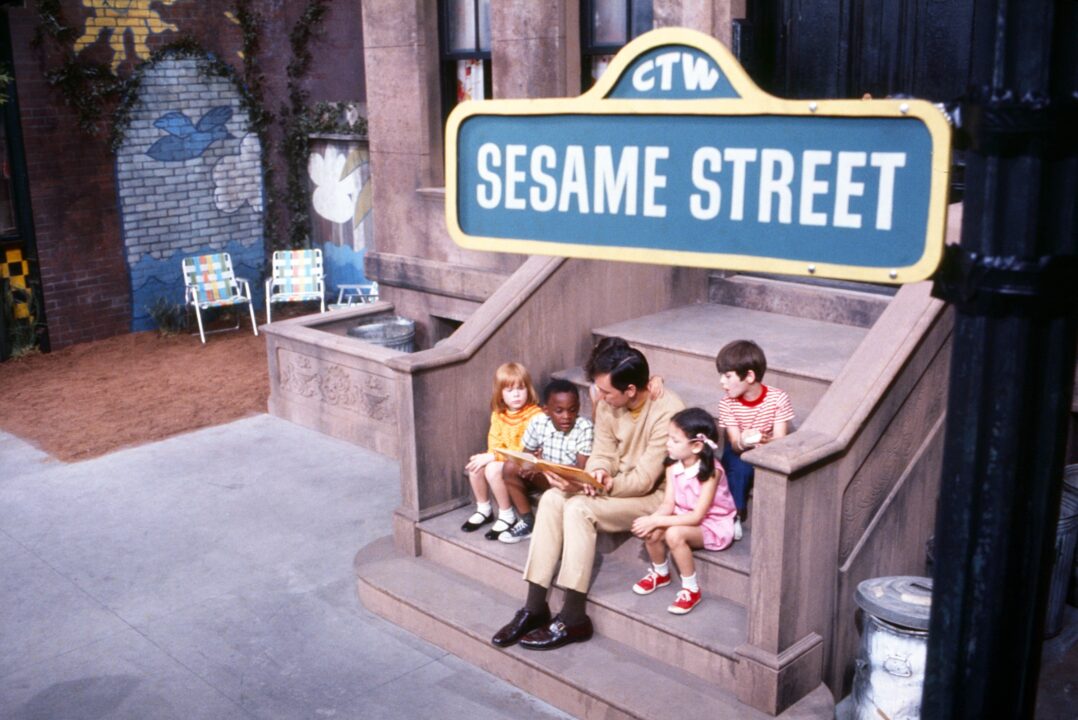
The environment of Sesame Street is a credit to director Jon Stone, who was committed to the idea of an inner-city setting, even against the objections of his colleagues. “I wanted something really funky and down-to-earth,” he later said, as Gikow recounted in Sesame Street: A Celebration.
“For a preschool child in Harlem, the street is where the action,” Stone explained in an interview for the Michael Davis book Street Gang, per Smithsonian Magazine. “Our set had to be an inner-city street, and more particularly it had to be a brownstone so the cast and kids could ‘stoop’ in the age-old New York tradition…”
And so Stone had set designer Charles Rosen scout locations in Harlem, the Upper West Side. And originally, the set was designed as a line of buildings, with Bert and Ernie’s brownstone at 123 Sesame Street abutting a dirt patch that abuts the next building. Following the pilot episodes, however, the set was redesigned to feature a curved street that could accommodate more camera angles, Gikow reported.
And the verisimilitude paid off. Sonia Manzano, a Puerto Rican Bronx-raised actor who played Maria, told Smithsonian Magazine that when she first saw Sesame Street on TV in her college years, she said, “Hey! That’s my street!”
At first, the Muppets and the humans were kept apart

Sesame Workshop/Courtesy: Everett Collection
As Jim Henson’s official website reveals, he and fellow puppeteer Frank Oz collaborated with Stone to determine how to integrate the Muppets into the TV show. And for the pilot episodes, Muppets weren’t even included in the street scenes; only the humans were.
“At the time, educators were concerned that there would be a mix-up between fantasy and reality,” explained to WBUR in 2009. “They thought that children would have a difficult time adjusting to that.”
But test viewers ended up showing more interest in the Muppets than the humans, so the fuzzy and feather puppets were shown the way to Sesame Street as well — including Big Bird, who wasn’t originally part of the pilot episodes!