

‘Saturday Night Live’ Debuted as ‘Saturday Night’ 50 Years Ago: What Did Critics Say?





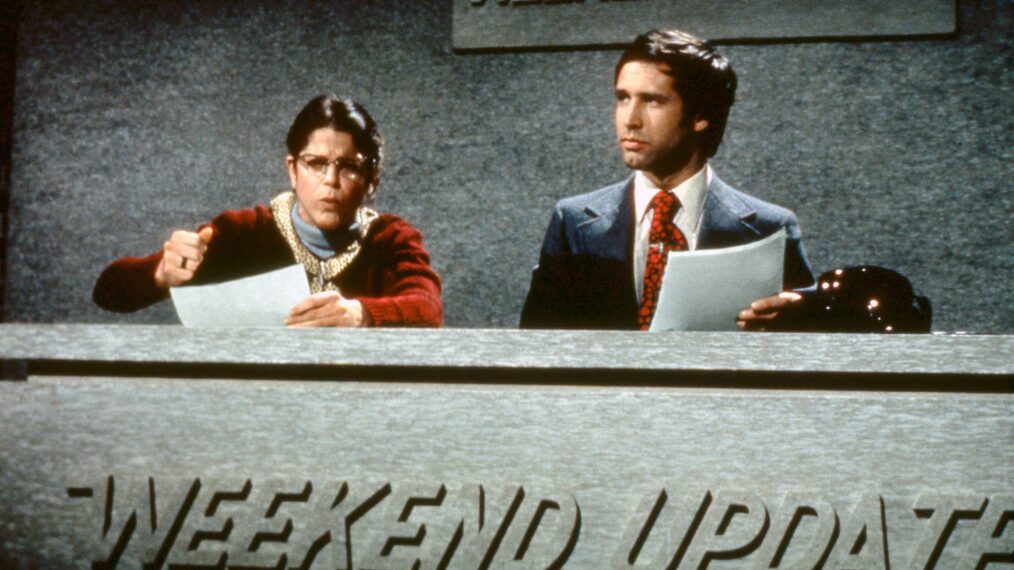
If you watched last year’s biopic Saturday Night, you already know the backstory behind Saturday Night Live’s debut. On October 11, 1975, the sketch-comedy show debuted under the name Saturday Night, with Lorne Michaels, then just 30 years old, shepherding the Not Ready for Primetime Players onto NBC airwaves.
Those players were Dan Aykroyd, John Belushi, Chevy Chase, Jane Curtin, Garrett Morris, Laraine Newman, Gilda Radner, George Coe, and Michael O’Donoghue. Stand-up comedian George Carlin hosted the first episode, folk singer Janis Ian and soul keyboardist Billy Preston were the musical guests, Albert Brooks shared a short film, and Jim Henson provided a Muppets sketch.
Some critics loved the results; others not so much.
The Hollywood Reporter said Saturday Night “got off to a less than auspicious start.”
“NBC’s live late-night musical-comedy series, Saturday Night, got off to a less than auspicious start with comic George Carlin as the opening night host,” Richard Hack of The Hollywood Reporterwrote in a review of the first episode. “The 90-minute show, which replaced reruns of The Tonight Show With Johnny Carson, was plagued throughout with a lack of exciting guests and innovative writing, helping to keep the debut at a lackluster pace.”
Hack said that the success of the show would hinge on an “immediate upgrading” of the material generated by the Saturday Night writers.
That said, Hack did commend the episode’s director, Dave Wilson, for having “handled his technical chores to perfection.” But perhaps the direction was a little too perfect. “Promos for the show stating, ‘It’s live, so anything can happen,’ only served to make the fact that nothing ever did that much more obvious,” he said.
The New York Times called it “dreadfully uneven” — but posted a better appraisal weeks later.
The New York Times critic John J. O’Connor wrote a scathing review of Saturday Night’s first two episodes. “Even an offbeat showcase needs quality, an ingredient conspicuously absent from the dreadfully uneven comedy efforts of the new series,” he wrote.
In particular, he took issue with the show’s fake TV commercials — especially a “tasteless and insensitive routine” that “used geriatric patients to demonstrate the longevity of certain batteries in heart pacemakers” — and Carlin’s “increasingly pretentious comedy lectures.”
By November 30 of that year, however, O’Connor was singing a different tune, praising the “incredibly adept” cast and the sketch quality. “In more recent weeks … at least 75 percent has proved to be sharply and sometimes wickedly on target,” he wrote. “NBC has found itself a source for legitimate pride, a commodity in scarce supply at any network these days.”
The Los Angeles Times said it could become “the freshest and most imaginative comedy-variety hour on the air.”
For the Los Angeles Times, staff writer Dick Adler gave high marks to Saturday Night’s debut in a review posted the following Monday. He lauded the talents of Chase, Brooks, and “a young man named Andrew Kaufman,” who recurred on the show.
“If NBC is looking for something unusual and attractive to bolster its sagging prime-time lineup, it could do a lot worse than shift its new Saturday Night series down a couple of hours,” Adler wrote. “Minus half its commercials, this bright and bouncy 90-minute outing … could become the freshest and most imaginative comedy-variety hour on the air.”
TIME said the unevenness made Saturday Night “endearing and human”
“Sometimes SN is awful,” TIME declared the following February. “Comedian Albert Brooks’ taped films were at first a regular feature, but offered only ten minutes of boredom. The Muppets are cloying grotesques.”
But the magazine hailed Saturday Night’s simplest jokes as its funniest — e.g. “a land shark who gobbles up apartment dwellers; a parody of Catherine Deneuve’s Chanel No. 5 ad which ended with a perfume bottle stuck to guest host Candice Bergen’s head.”
And the highs and lows were appealing, TIME decided: “SN’s most endearing and human quality is its unevenness.”
The New Yorker said the “truth is that it’s a funny show.”
The New Yorker’s Michael J. Arlen praised Saturday Night in a review after about a month of episodes — and shaded Bergen. “The truth is that it’s a funny show and has enough comic spirit behind it so that even an actress of no notable comic expertise, such as Candice Bergen, can work along easily with the program,” Arlen wrote. “What is attractive and unusual about the program is that it is an attempt, finally, to provide entertainment on television in a recognizable, human, non-celebrity voice…”
Little did any of those critics know the show that started its life as Saturday Night would still be dividing audiences 50 years later!